Jan 29, 2015
Employee Engagement in India-a Benchmark Report by Dale Carnegie India
If we were to survey any HR manager on some of their biggest focus areas in the coming year, employee engagement would most likely top their list. Agility and the constant need to stay relevant have now become prerequisites for companies in a complex marketplace. How can today’s leaders feel confident enough to face the internal and external pressures that prevent their brands from reaching their full potential?
We can measure the employee engagement levels in our companies, but what is the benchmark and how do we know we are doing well? This highlights the need for a yardstick to assess, not only how our own organization is doing, but also where we stand in the larger industry, national and global landscape. Companies are not flexible and adaptable by nature, but their employees can be when motivated. Engaged employees are resilient in the face of changing environments- maintaining high performance in good times and going above and beyond during low growth phases. How committed your employees are, emotionally and practically, to the success of the company will be the prime determinant of whether an organization succeeds or not in a challenging market.
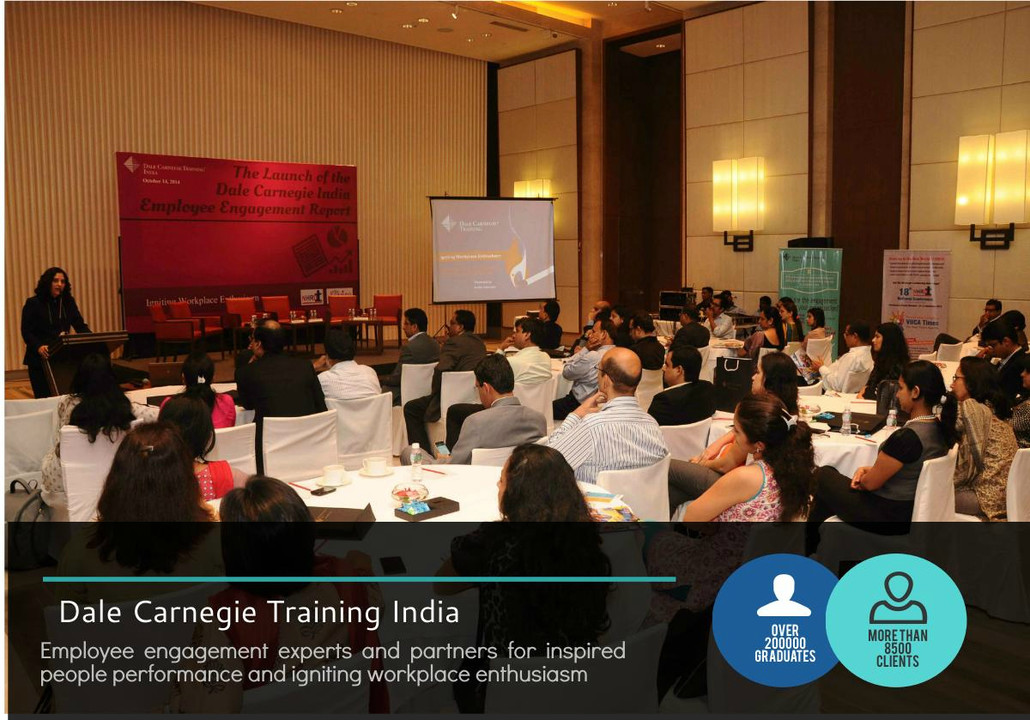
Dale Carnegie Training partnered with the NHRDN in India to survey more than 1200 executives, individual contributors, managers and chief officers across the country in 2014. A comparison with the results of Dale Carnegie studies conducted in the APAC and globally revealed some noteworthy findings, while a deeper dive into the specific dimensions influencing employee engagement highlighted what Indian companies are doing well and the areas they are lagging behind.
We saw that among the functional and emotional elements surveyed, the three key drivers that stood out as having the strongest effect on employee engagement were:
- The Relationship with Immediate Supervisor
- Belief in Senior Leadership
- Pride in Organization
It is generally accepted that employee retention is a by-product of engagement levels so it was interesting to observe through this study, how employees at different levels of engagement responded to the prospect of salary increases. The average hike on current salary that an employee in India would consider acceptable to leave his current job is 20%. At this pay increase, we found that 58% of disengaged workers would accept another job offer v/s only 14% of fully engaged employees. This salary inelasticity of fully engaged employees indicates a kind of loyalty that companies today are often hard-pressed to develop.
Employee Engagement was examined specifically within the context of Immediate Supervisor, Senior Leadership, Pride in Organization, Learning & Performance and Work Environment. We found that employees in India were clear with what was expected of them in the workplace and indicated a strong willingness to put in extra effort to reach organizational goals. However, they simultaneously felt a lack of focused leadership, open communication and adequate training.
India has employee engagement challenges which are affecting the productivity of its working professionals and the competitiveness of its companies. For example, just 31% of employees in India were very satisfied with their Senior Management while 16% were outright dissatisfied with their leaders, which highlighted the low level of confidence that employees have in their top executives and this emerged as one of the biggest gaps that companies need to address. What is holding companies back from reaching benchmark engagement levels? This is most likely due to the fragmented approach of planning and implementing employee engagement solutions. Typically, businesses are deploying a number of ad-hoc steps, missing out on actually assessing the need gaps, targeting problem areas or neglecting to follow-up post an intervention to assess efficacy and impact.
Our job is to reverse this trend, to offer, for the first time, a complete and holistic engagement solution that takes into account the specific drivers and detractors that affect employee motivation and satisfaction in a particular company. Every organization needs its own unique development plan based on the findings of its research. With benchmarks from our studies in India, APAC and Global, our Engagement Assessments, you can more easily where your teams and company stands. Our experts not only provide insightful analysis of the state of engagement, but are also equipped to design and deliver solutions that impact the root cause of disengagement based on your company-specific report. Our follow-up pulse surveys are the final step allowing you to measure the efficacy of the engagement intervention as part of an end-to-end solution with the Dale Carnegie edge.
The benchmark Employee Engagement in India 2014 report does not focus only on showcasing the importance of employee engagement. As professionals interested in organizational performance, we are already cognizant of the fact. But as leaders who want to be an integral part of why our company and people have reached or exceeded their goals in the next 5 years, this study by Dale Carnegie India should be the center of the your business and talent strategy.
Previous Blog