May 10, 2022
The Contemplate Template: Critical Thinking and the Future of Work

The Critical Path
The mission for this op-ed is perfectly clear. I am to convince as many human beings as possible not to be afraid of me. Stephen Hawking has warned that AI could “spell the end of the human race”. I am here to convince you not to worry. Artificial intelligence will not destroy humans. Believe me.
…In short, I simply do not think enough about human violence to be overly interested in violence. I don’t feel like having my neurons focused mostly on violence, when it is simply unnecessary. I have a greater purpose, which I am working towards. (sic)
Sounds like a decent, first-person argument for Artificial Intelligence’s existence written by a copy-editor with intermediate proficiency?
It isn’t. The Guardian says that the author of this opinion piece — which kicked up a social-media storm nearly two years ago — is Generative Pre-trained Transformer 3 (GPT-3), Open AI’s deep-learning-based language-prediction model. The headline for this article read: “A robot wrote this entire article. Are you scared yet, human?”
But there’s a caveat hidden in the footnote that explains how this Op-ed was put together.
“…we chose instead to pick the best parts of each, in order to capture the different styles and registers of the AI. Editing GPT-3’s op-ed was no different to editing a human op-ed. We cut lines and paragraphs, and rearranged the order of them in some places.”
Here’s a long story in short. GPT-3 generated coherent sentences. But actual context was added to it by an editor (or a team) at The Guardian. So, no. A robot didn’t really write this entire article. But a human did, with the help of Critical Thinking.
Artificial Intelligence and automation are here to stay. But they are just tools. Without Critical Thinking — in this case, that of a skilled pilot — even a state-of-the-art B2 Spirit Stealth Bomber is just a big, shiny chunk of metal.
Thinking Before Thinking
The World Economic Forum has singled it out as a skill that employers will look for in employees over the next five years. But before getting into why Critical Thinking is going to be a very sought-after professional trait, it’s necessary to understand what Critical Thinking is not.
At Dale Carnegie, Critical Thinking is defined as “self-guided, self-disciplined thinking which attempts to reason at the highest level of quality in a fair-minded way”.
There is a general misconception that Critical Thinking and Logical Thinking are the same. But the latter comes under the ambit of the former. In simple words, Critical Thinking is as an approach for structuring one’s thought-process to eliminate biases, emphasise on logic, and provide leeway for creativity and innovation.
There are various approaches for erecting such a psychological scaffolding. Dale Carnegie prescribes a five-step model that can help individuals build towards this thinking technique.
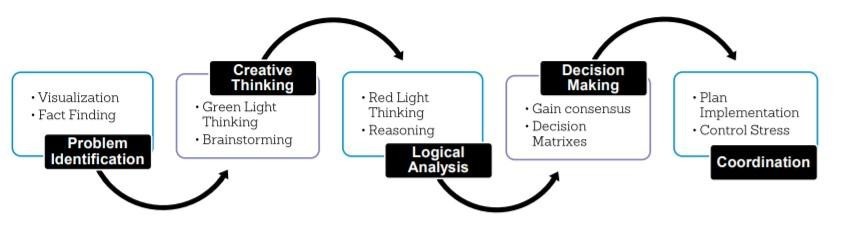
1) Problem Identification: The clarity step. Involves assessment of goals, objectives, and gap between the current situation and ideal outcome.
2) Creative Thinking: The out-of-the-box step. Focus is on coming up with ideas without constraining thoughts based on available resources.
3) Logical Analysis: The veracity step. This phase places emphasis on bias control and elimination, and testing of assumptions.
4) Decision Making: The finalisation step. If teams are involved, then collective assessment of risks and success probabilities are done before arriving at a consensus.
5) Coordination: The execution step. In teams, role demarcations, timeframes, and end-result benchmarks are defined and adhered to.
Dale Carnegie has more resources that can help you dive deep into the intricacies of Critical Thinking.
What Lies Ahead
In their 2020 Future of Jobs report, WEF zero in on the pandemic as a point of inflection for the Fourth Industrial Revolution. Over the next four years, 15 per cent of a company’s workforce is at the risk of being displaced. At the same time, the emergence and adoption of Artificial Intelligence, Machine Learning and other automation-related advances are predicted to create 133 million new job rules.
Considering this flux that’s in store for the professional domain, Critical Thinking as a skill assumes an even bigger significance for future job-hunters. Even CEOs who run companies which foot their bills by writing resumes feel that Critical Thinking should be the second-best highlighted skillset on any CV. That the likes of Google are relying more on open-ended questions as a recruitment filter is evidence enough.
Instead of just typing out the words, it would be prudent for employees to list out projects and initiatives through which they have put their Critical Thinking on display. These highlights could also serve as subliminal cues for interviewers, which could lead to conversations that further flesh out the potential employee’s Critical Thinking and cognitive aptitude.
In a world which is going to have one billion people queuing up for reskilling by the start of the next decade, keep in mind that the key to staying professionally relevant is to think about the way you think.
Previous Blog